

Disclaimer: These posts represent the views and opinions of the author and are not endorsed by nor reflect the official position of the FDA, ISPE, GAMP or any other organisation referenced here.
Martin had run validation governance at his company for six years. Three completed inspections, zero critical findings. His audit trail review programme was properly documented: quarterly cadence, signed off by senior QA, procedure tracing back to Annex 11 and 21 CFR Part 11. When an FDA inspector arrived for a routine surveillance inspection of their electronic batch record system, Martin wasn’t worried.
The inspector spent 90 minutes looking at audit trails. In those 90 minutes, she identified a pattern Martin’s team had generated records about for three years without ever seeing: batch record modifications concentrated in the 4-hour window before each release decision, attributed to two specific user accounts, with no associated deviation records or change control entries anywhere in the system.
Nothing in the records was missing. Every modification was timestamped, attributed, and retrievable. The audit trail was complete. The review procedure had been followed correctly every single quarter.
What the procedure had never asked was whether the pattern made sense.
Martin’s team wasn’t negligent. They weren’t cutting corners. They were doing exactly what their procedure told them to do. And their procedure was measuring the wrong thing.
This is the compliance gap most pharmaceutical organisations carry quietly into every inspection. The technical requirement for audit trails is well understood and broadly met. The thinking required to make those records mean something is still treated, in most organisations, as optional.
What audit trail review is not
Before covering what a mature audit trail programme looks like, it’s worth naming clearly what it isn’t — because the misconceptions drive the problem.
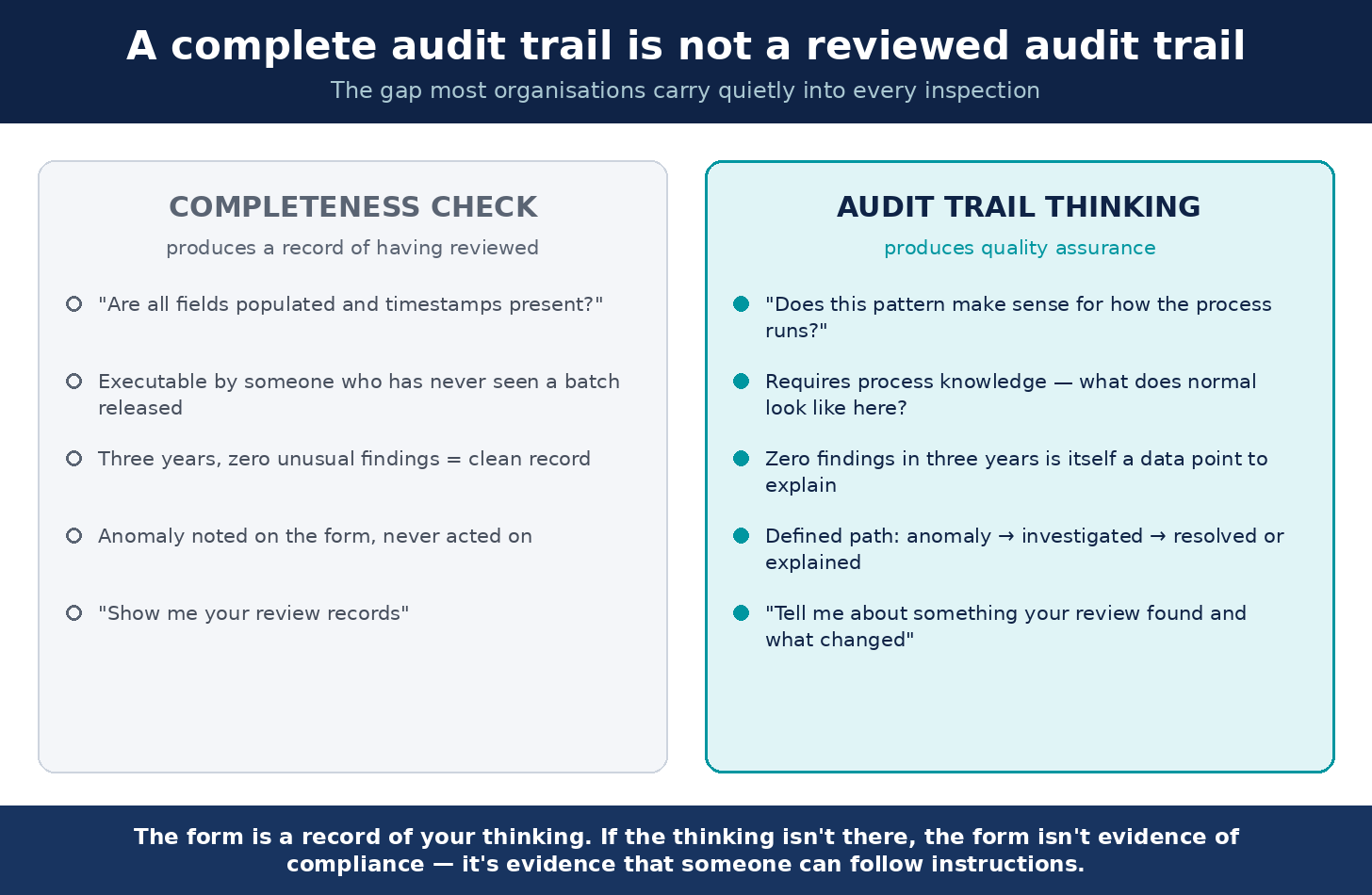
Audit trail review is not a completeness check. Confirming that all required fields are populated, timestamps are present, and records are accessible takes care of the regulatory minimum. It does not produce quality assurance. It produces a record of having conducted a review. The distinction matters when an inspector asks you to explain a pattern, not produce a form.
Audit trail review is not IT’s job once the system is validated. System configuration keeps audit trails running. QA analytical thinking makes them useful. These are different activities, requiring different expertise, and conflating them is how review programmes end up technically operational but practically blind.
Audit trail review is not about proving nothing went wrong. The purpose of a functioning review programme is not to confirm normalcy. It’s to detect when the pattern of activity doesn’t match what the process should look like — and then investigate why. A programme that has never found anything unusual over three years isn’t evidence of a clean system. It’s a data point that requires explanation.
And most importantly: audit trail review is not a documentation exercise. The form you produce is a record of your thinking. If the thinking isn’t there, the form isn’t evidence of compliance. It’s evidence that someone can follow instructions.
Why critical thinking erodes in validation
Audit trails are one symptom of a broader pattern. Critical thinking in validation means the ability to evaluate evidence, identify assumptions, spot anomalies, and reach conclusions a reasonable expert would find defensible. It’s the same skill required for meaningful risk assessments, thorough deviation investigations, and credible change impact analyses.
It’s also the skill that deteriorates when validation is run primarily as a documentation exercise. When the measure of a validation activity is whether the form is completed correctly, the people completing the form stop looking for anything else. The form becomes the outcome. The risk assessment becomes the template. The audit trail review becomes a completeness check with a signature at the bottom.
The FDA’s direction toward CSA is partly a recognition of this erosion. The guidance is asking organisations to demonstrate they’ve thought about their systems, not just processed paperwork about them. Audit trail review is one of the clearest tests of whether that thinking is real.
Here’s the test: if your review procedure can be executed by someone with no understanding of the underlying process — someone who’s never seen a batch released, doesn’t know what a deviation investigation looks like, and has no sense of what normal activity patterns should look like in your systems — then the procedure is measuring the wrong thing. Competent people following a flawed procedure produces flawed outcomes. The procedure is the problem.
Five diagnostic patterns that carry real value
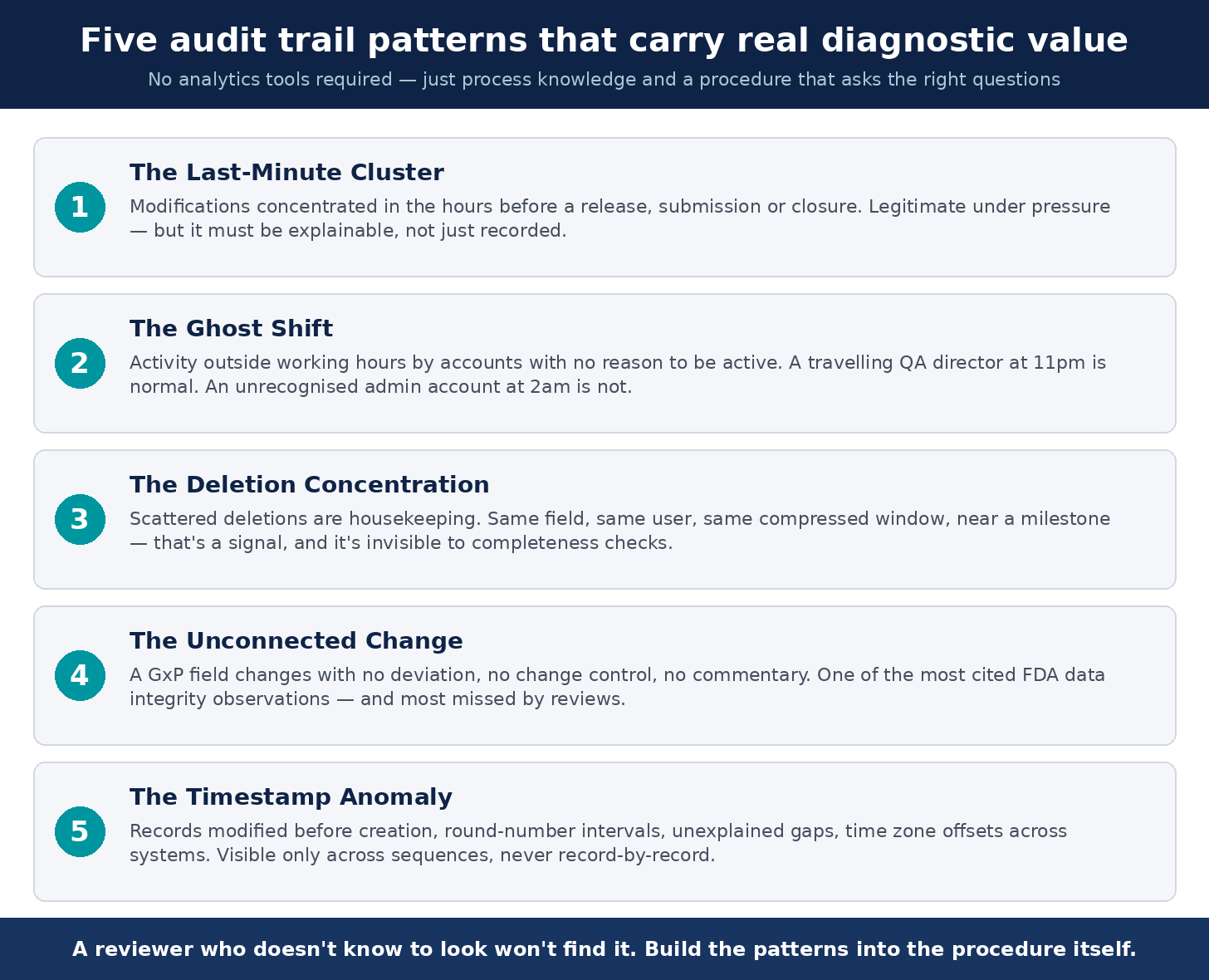
Effective audit trail review builds in specific analytical questions alongside format checks. These five patterns carry the most diagnostic value across GxP environments. None requires sophisticated analytics tools. Each requires someone with enough process knowledge to recognise when activity is unusual, and a procedure that directs their attention toward the right questions.
1. The Last-Minute Cluster
Data modifications concentrated in the hours immediately before a release decision, a regulatory submission, or a deviation closure. Clustering around milestones is worth understanding, not just recording. The activity may be entirely legitimate — compressed timelines, last-minute specification corrections, under-pressure quality events are all real. But the pattern should be explainable by someone who can describe the operational context, not just confirm the records are present. A useful review question: is there a documented reason, visible in the associated records, for the concentration of activity at this point in the timeline? If no, that’s a gap requiring investigation — not a finding, but a question that needs an answer before the review closes.
2. The Ghost Shift
Activity outside working hours by accounts without an obvious operational reason to be active at that time. Administrative accounts with elevated privileges modifying GxP records at 2am on a weekend. User accounts attributed to employees who are documented as being on leave. This pattern generates the most uncomfortable conversations and also the most legitimate explanations. A Quality Director approving deviations from a hotel at 11pm because they’re travelling internationally is normal and explainable. An unrecognised account modifying specification fields during an unmaintained period is not. The procedure needs to distinguish between them explicitly. Most procedures detect both the same way: the record exists, the timestamp is present, the review is complete. That’s not adequate for this pattern.
3. The Deletion Concentration
A small number of deletions across a large system is expected. Fields get corrected, entries get voided, and housekeeping happens. A concentration of deletions in specific fields, attributed to specific users, within a compressed time window is a different kind of signal. The analytical question isn’t “did deletions occur?” It’s about pattern: same field type across multiple records, same user account over a short window, same time period as a release or submission milestone. Building the concentration question into the review procedure explicitly is how you make the distinction findable rather than invisible.
4. The Unconnected Change
A GxP record field changes. No deviation record. No change control entry. No commentary in the audit trail explaining the modification. Some unconnected changes are housekeeping. A data entry correction with a brief narrative attached is different from a specification value change with no associated documentation anywhere in the system. The review procedure needs to treat them differently — which means defining what constitutes an acceptable rationale for an undocumented change, and what triggers an investigation. This pattern is one of the most consistently cited in FDA observations about data integrity. It’s also one of the most consistently missed by review procedures that check for the presence of records rather than the coherence of the change landscape across records.
5. The Timestamp Anomaly
Time zone mismatches across integrated system components. Records that appear modified before they were created. Timestamp sequences that cluster in round-number intervals, suggesting automated generation rather than authentic user activity. Gaps in timestamp sequences that don’t align with any documented maintenance window. These anomalies can indicate configuration problems, data integrity risks at the system level, or clock synchronisation failures across distributed infrastructure. They’re easy to miss in record-by-record review and visible only when you look at sequences and intervals across a data set. A reviewer who doesn’t know to look for timestamp patterns won’t find them. Building the pattern explicitly into review design is how the procedure does the work the reviewer might not know to do independently.
Building a review programme that actually finds things
The structural choices that separate insight-producing review from form-producing review are few but consequential.
Match reviewer expertise to the process, not just the system. The reviewer needs sufficient understanding of the underlying process to recognise when an activity pattern is unusual. This doesn’t mean always assigning senior staff. It means being explicit about which systems require process knowledge — not just system knowledge — and designing reviewer assignment and training accordingly. For systems handling critical quality data — batch release workflows, electronic signatures on CAPA closures, data flowing into regulatory submissions — the review needs someone who understands what normal looks like in those processes. Not just what complete looks like in the records.
Build exception handling into the procedure, not just the checklist. Most audit trail SOPs describe what to check. Fewer are specific about what to do when the check produces an unusual result. The procedure needs a defined path from “anomaly identified” to “anomaly investigated, documented, and resolved or explained.” Without that path, unusual patterns get noted on a review form and never acted on. The programme produces a false sense of assurance. The form is complete. The question wasn’t answered.
Make the sampling strategy explicit and defensible. Modern systems generate audit trail volumes that make reviewing every transaction impractical. Sampling logic needs to be documented and proportionate to risk: which transaction types, from which modules, over which time windows, at what frequency, and why those choices connect to the risk profile of the underlying process. When an inspector asks why you reviewed the transactions you reviewed, the answer needs to be grounded in risk reasoning, not in what fit comfortably into the review schedule.
Run periodic second-look reviews. Every six to twelve months, have a senior quality professional review a sample of completed audit trail reviews against the underlying data, independently of the reviewer who produced them. Not as a policing activity. As a calibration: is the review procedure producing the insight it was designed to produce? This is one of the most valuable and least-practised elements of mature programmes. The reviews look thorough. The second look shows whether they were.
The integrated environment problem
The audit trail question becomes materially harder when GxP data travels through multiple systems before reaching its final form. When I supported a cloud migration programme involving more than 2,000 servers across a quality-critical technology stack — completed across six months, across multiple regulatory jurisdictions — audit trail continuity at system boundaries was one of the areas requiring explicit validation attention from the earliest design stage.
In a manufacturing environment where data moves from process control through MES to ERP to the electronic batch record, the audit trail for a single data point spans four systems. The integrity of the overall record depends on every link in that chain functioning correctly and consistently. Each interface is a potential failure point. Data gets transformed in transit. Timestamps can offset across different system clocks or time zones. Records can appear on the receiving system without fully capturing the provenance of what happened at the source. And the audit trail on the receiving end may look complete while missing the context that only exists on the sending side.
Validating the interface means validating not just that data passes through it correctly, but that the audit trail on the receiving side accurately reflects what happened at the origin. That’s a different validation question than most interface test scripts are designed to answer. The infrastructure that keeps audit trails trustworthy across system boundaries creates more lasting protection than a large volume of test scripts run once at implementation. Systems change. Configurations drift. Monitoring that continuously confirms audit trail integrity at interfaces catches degradation before an inspection does.
Cloud QMS deployments add another layer: your vendor holds the underlying infrastructure audit trail, but you remain responsible for the GxP audit trail of user activity within the application. Understanding exactly where that boundary sits — what the vendor’s SOC 2 report or ISO 27001 certification actually covers versus what you need to validate independently — is a gap that appears frequently in cloud validation programmes and rarely gets resolved before it becomes an inspection question.
How roles shift when review becomes analytical
When an audit trail programme moves from format checking to pattern analysis, the roles involved change in specific ways.
Validation specialists and QA reviewers shift from evidence producers — completing forms, checking fields, accumulating signatures — to evidence interpreters. They use audit trail patterns to ask questions about the process, surface anomalies before they become findings, and challenge the rationale behind unusual activity. The question shifts from “Is the record complete?” to “Does this pattern tell me something about how this process is actually running?”
Quality managers shift from completeness gatekeepers to analytical reviewers. Rather than confirming that reviews happened, they focus on what the reviews found, whether the findings were investigated adequately, and whether the programme’s detection capability is calibrated to the actual risk landscape of the systems it covers.
And inspectors, when they encounter a mature programme, shift their questions accordingly. Instead of “Can you show me your audit trail review records?”, the question becomes “Tell me about something your review identified and how you handled it.” That’s a more substantive conversation. It’s also one you can only have if the programme has actually been finding things.
What the inspection is really testing
When an FDA or EMA inspector examines your audit trail review programme, the most credible answer describes the thinking behind it — not just the procedure. You can show a completed review form and a signed SOP. The question underneath is more pointed: do the people doing this review understand what they’re looking at, and would they recognise something wrong if they saw it?
That question isn’t answered by the procedure. It’s answered by how the procedure was designed, who does the work, how they were trained on the specific processes behind the systems they’re reviewing, and what the programme has actually produced over time.
The organisations with the most credible audit trail programmes I’ve worked with share one specific characteristic: they can describe specific anomalies their review identified, explain how those anomalies were investigated, and show what changed in the process or the system as a result. That narrative — anomaly found, investigated, corrected — is what a functioning review programme looks like in practice.
It’s also what inspectors are trying to determine whether you have. The presence of that narrative means the programme is working. The absence of it, across a multi-year review history with no unusual findings, means one of two things: either nothing unusual ever happened in your systems, or the review wasn’t designed to look for it. Experienced inspectors are good at distinguishing between those two possibilities. The time to make that assessment yourself is well before an inspection makes it for you.
Sachin Bhandari is Principal Consultant at Trustbridge Compliance. He works with pharmaceutical organisations on validation governance, audit readiness, and digital quality strategy. These are his personal views.